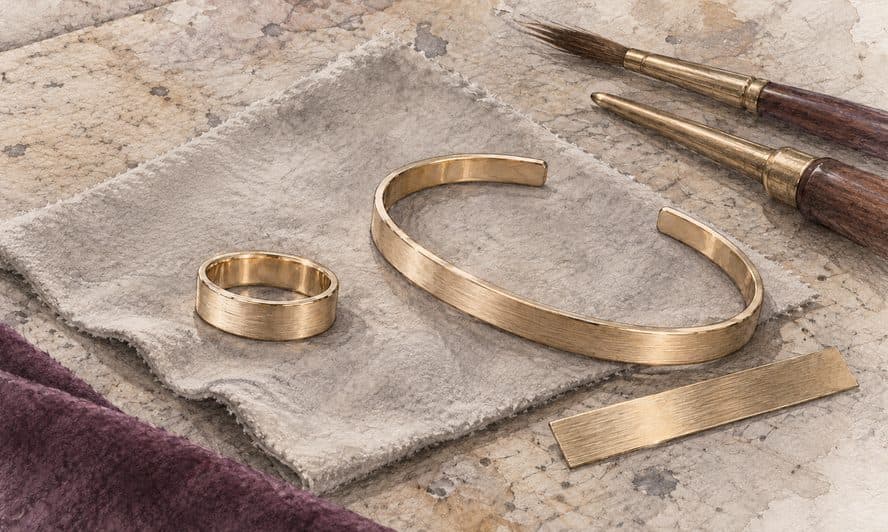
Cross-selling in the luxury boutique
Four in the afternoon, the boutique is quiet. A client came in for a wedding band, he tried three of them, he has chosen. Across the forty minutes that preceded it, he talked about the date, about a trip to Rome last year, about his partner's habit of wearing all her jewellery together. The advisor heard every word of it. As she settles the band into its case, she knows which other piece would go with that band, and she would know how to say why. She says nothing. She wraps, she walks him to the door, she says goodbye.
The boutique director followed the end of the sale from a distance. He will hold nothing against her, because he knows that the missing sentence is not a question of commercial nerve. This advisor was not afraid of selling. She was afraid of breaking something that had just gone well.

That is the blind spot of cross-selling training in luxury. It treats a problem of boldness when what it is dealing with is a problem of legitimacy.
Why does the second proposal never come out?
Put the question to a team and you will rarely be told "I don't dare". You will be told "it would not have been the moment", "the client was already well looked after", "I did not want to give the impression of pushing".
Translated, those three answers say the same thing: the advisor has no reason at his disposal that belongs to the object. A reason that belongs to a commercial target shows. A reason that belongs to a script is recognised for what it is. A reason that belongs to the piece itself, to its material, its technique, its care, the way it is worn with the one that has just been chosen, does not look like selling. It looks like advice, because that is what it is.
It is for that reason that cross-selling in luxury is, above all, a problem of product depth. An advisor who knows his collection at the level of the product sheet can describe. An advisor who knows it at the level of the craft can connect. And connecting two pieces in front of a client is exactly what turns a proposal into a recommendation.
Three ways of cross-selling in the boutique
By the number. The average basket target comes all the way down to the morning briefing, and the second proposal becomes an obligation to deliver. The client does not see the target, but he picks up its trace: an insistence very slightly out of step with the conversation he has just had.
By the formula. Other areas of retail have built highly effective forms of words for proposing an add-on, and they work because the purchase there is quick and the add-on obvious. Transposed into a boutique where the sale lasts forty minutes and commits a considerable sum, they introduce a transactional register into a sequence that is not one.
By the objective link. The advisor proposes because a real relationship exists between the two pieces: the same manufacturing technique, a material that ages in the same way, a shared care routine, a use that completes the other. That third route is the only one that survives the level of exactitude luxury demands, and it is the only one that asks for something other than training in phrasing.

Product depth makes the second recommendation credible
The objective link cannot be improvised, and the difference comes down to a single sentence. Faced with a wedding band and a bracelet, an advisor who has the product sheet at his disposal will say that both are in yellow gold and that the bracelet comes in three sizes. That is accurate and it connects nothing. An advisor who has the maison's material at his disposal will say that the two pieces are worked according to the same process, that this process gives light the same way of travelling across the metal, and that the day the band comes back for a check, the bracelet will follow the same route through the workshop. The second sentence connects, because it describes a property of the object and not a commercial opportunity.
That material has one particularity that governs everything else: it exists nowhere other than with you. The processes of your workshops, the vocabulary your maison has fixed, the reasons two collections answer one another appear in no training catalogue. A generic module can teach the structure of a recommendation. It cannot supply the one thing that makes it credible, which is the content.
This is why cross-selling in the luxury boutique is treated first as a matter of product knowledge, and only then as a matter of sales technique. The reverse order produces advisors who know how to build a sentence and have nothing to put in it.
Where the material that connects two pieces comes from
That material has to be worked, and it is worked as maison content. The product training built for Bvlgari is cited here for that precise reason: it installs in the advisor the heritage of a maison, its craft and its care advice, which is to say exactly the three registers from which a reason for a second proposal is drawn. A name such as Tubogas stops being a catalogue reference and becomes a signature whose origin the advisor can recount and whose handling he can explain. It is that shift, rather than any training in phrasing, that gives the advisor something to say at the moment of connecting two pieces in front of a client.
What actually gets practised
Once the material is acquired, four gestures can be worked on, and they are worked on separately.
The reason. Putting into one sentence the objective reason that connects two pieces. This is an exercise in production, not in recall: the advisor has to produce the sentence, not recognise it in a list.
The moment. Spotting, within the course of a sale, the point at which a second proposal extends the conversation instead of interrupting it. That point does not sit in the same place from one client to the next, and that is precisely what makes it impossible to write into a procedure.
The phrasing. Proposing while leaving a way out. A sentence that does not oblige the client to refuse explicitly changes the nature of the exchange entirely.
Stepping back. Hearing the first signal of disinterest and stopping, without repairing, without rephrasing, without insisting. It is the least taught gesture and the one that protects the experience most.
Those four gestures share one property: they are decided in a second, in front of a client who has just said yes. Rereading the list of admissible reasons makes nobody capable of choosing the right one at the moment it has to be chosen. Stepping back, above all, is learnt only by having got it wrong: you have to have insisted once too often and seen what that takes away from a sale that had gone well until then.
The format has to fit within the sales floor
A boutique team has no continuous training slots at its disposal. It has intervals: before opening, between two clients, during a quiet hour. This is why a short format, solo and on mobile, fits that rhythm more readily than a long session, and several serious providers now offer exactly that to maisons.
What separates the proposals is decided elsewhere. Cross-selling training has value only if the pieces it teaches advisors to connect are yours, with your processes and your workshop vocabulary: the mechanics and the product content therefore have to be written together, failing which you get a standard module filled with your names. Emraude designs and develops its experiences in-house, from framing to delivery. The person building the exercise and the person checking the technical term work in the same team, and a badly formulated reason for a recommendation is corrected in one iteration instead of going back into specification with a third party. It is that organisation which structures the cross-sell and up-sell programme built for luxury.
Measuring the move upmarket without reducing it to average basket
Average basket is an indicator of result, not of competence. It rises for bad reasons, falls for good ones, and conflates two distinct gestures within a single aggregate: the second piece sold and the move upmarket. Tracking the number of items per ticket and the average price per item separately tells you which of the two has progressed. Used on its own, it pushes mechanically towards the proposal by the number, the one the client picks up.
A practice experience makes it possible to look upstream of that result. It shows which notion of craft holds, which reason for a recommendation remains vague in which team, and which of the four gestures are lost first when the boutique is busy. Those signals do not tell you that the basket has risen. They tell you why it is not rising, which is the only information a training plan can act on.
The protocol stays simple: choose an indicator observable in the boutique, measure it before and after, over a period long enough to absorb seasonality.
Three articles complete this one: cross-sell, up-sell, add-on sale: the guide separates the four terms and brings them back to the real gestures of the boutique, selling more without ever pushing deals with the objection of maisons that refuse the second proposal on principle, and the selling ceremony in luxury places this moment within the full course of the sale.
Frequently asked questions
Is cross-selling compatible with the positioning of a luxury maison?
Yes, provided the proposal rests on a real relationship between the objects and not on a basket target. A client who understands why two pieces go together receives advice. A client who does not understand it receives a solicitation, and he tells the difference immediately.
Should advisors be given scripts?
A script reassures at the start and is quickly spotted in the boutique. It is more useful to have the advisor produce his own forms of words from solid product material, then have him practise them. The phrasing becomes his own, which makes it far less detectable.
At what point in the sale should the second proposal arrive?
Before the close, while the conversation is still open, and never at the till. A proposal made during the exchange extends the exchange. The same proposal made after the decision arrives within an exit sequence, where the client has already mentally closed the visit, and where any approach looks like an approach.
How do you handle the move upmarket without disqualifying the client's choice?
By never presenting the higher piece as a better choice, but as a different choice, with the property that distinguishes it. A client who hears "this one is more beautiful" understands that his own is being judged. A client who hears in what way the process changes at that level receives information and decides on his own.
Your advisors know the collection by heart and never connect two pieces in front of a client. Request a demo